|
|


|
Home About the C.E.U. congress Program Speakers Registration Travel to Oslo and hotels Venue Tours and events Press Contact |
|||||||
|
|
TOURS - Guided tours of Oslo,
Saturday September 13:
You can book a tour when you pay the
registration fee
by credit card, see the registration page;
https://www5.shocklogic.com/scripts/JMEvent/Registration.asp?Client_Id='CC'&Project_Id='2833'&Form_Id=1&Form_Number=1&Stand_
Id=0&A=&Language_Code=
You can also book a tour by email
-
audun.engh@gmail.com - , and pay cash on site in
Oslo. Additional tours will be arranged if they are sold
out.
Description of the tours:
Tour 1:
09.00 - 13.00 Walking tour, Downtown Oslo
with expert guide. (main street Karl Johan,
University, City Hall, Parliament, the downtown 17th
century grid, the harbour regeneration, the new opera
house) NOK 200 (approx. EUR 25, USD 40).
Tour 2: 09.00 - 13.00 Bus tour, The Urban Neighbourhoods of Oslo (19th century urban development in wood and brick, neo-classicist social housing projects from the 1920s) NOK 300 (approx. EUR 37, USD 60). 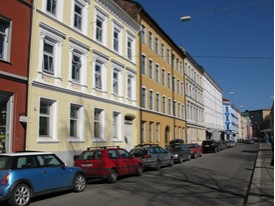 Grünerløkka, an urban extension from1880-1890, with the four-story apartment buildings very typical for Oslo. (Tour 2) Tour 3: 09.00 - 13.00: Bus tour, Highlights of Oslo, including:
The Viking Ship Museum: Ships built 800
-900 A.D. found in large burial mounds, with burial
furnishings
http://www.khm.uio.no/utstilling/faste/vikingskipene/index_eng.html
Norsk Folkemuseum -
Norway's largest museum of cultural history featuring
the world's oldest open air museum http://www.norskfolke.museum.no/en/
The vernacular wooden architecture of Norway; stave
church built in the 12th century, medieval and newer farm
houses from various rural districts in Norway and the
Old Town with the 19th century Apartment Building.
NOK 325 incl. admission) (approx. EUR 40,
USD 65
-----
MEETING POINTS FOR TOURS: Walking tours: University Square, Karl Johan Street, across the street from the National Theatre Bus tours: Fridtjof Nansens Plass, the sircular square behind the City Hall.
PRE-CONFERENCE SEMINAR:
Hosted by ESUA; European School
of Urbanism and Architecture.
Håndverkeren Conference Center,
The European School of Urbanism and Architecture: a model
curriculum for
an age of globalisation
ESUA, a partner organisation
for the Oslo Congress, will present and discuss the results
from a two-year pilot project, 2006-2008, funded by the
European Union "Leonardo da VInci" programme in vocational
education and training, to develop a curricumum for
integrated European urban and architectural study.
Speakers and
panelists will include
Michael Mehaffy,
Gabriele Tagliaventi, Chuck Bohl, Sandy Sorlien, Joanna
Alimanestianu, Harald Bodenschatz, Tigran Haas,
The ESUA programme
features:
* The latest advances in best practice on sustainability and climate change * integrated study of urbanism with architecture * inter-disciplinary education * immersive, project-based learning * exchange studies across national boundaries * emphasis on local and historical resources as a basis of sustainable economics * first-hand studies of local architectural, urban and cultural histories * the economic and cultural value of local identity and tradition
Read more:
www.esua.org
---------------
CLOSING PARTY - TUESDAY SEPTEMBER 16:
20.00 - 02.00: Closing party, hosted by the Cuban and Norwegian chapters of C.E.U. CLIMATE EXCHANGE - A Scandinavian - Caribbean Evening. Cajun and Norwegian food, Cuban music, welcome speech by Julio Cesar Perez, Chair, C.E.U. Cuba.
Venue to be announced. Tickets will be for
sale at the registration desk during the congress.
---------
POST CONFERENCE TOUR
Wednesday, September 17 -
Saturday, September 20:
Optional rail tour of
Norwegian fjord country, coastal towns like Bergen and
vernacular settlements. We will examine the impact of
climate change; and the value and embodied energy of
traditional and regional architecture. Please contact
Audun Engh,
audun.engh@gmail.com for further information and if
you would like to reserve a place for this tour.
Departure from Oslo in
the morning September 17, return to Oslo in the evening
September 20.

One
of the neo-classicist social housing projects from 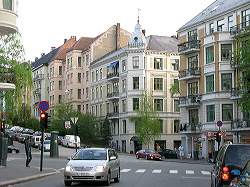 1890s housing apartment buildings, Frogner
|
|
THE NEW OSLO OPERA HOUSE - OPENED APRIL 2008 
http://arts.guardian.co.uk/art/
architecture/story/0,,2275258,00.html http://www.arcspace.com/architects/ snoehetta/oslo_opera/oslo_opera.html A mountain of music The sloping marble roof of the Oslo opera house may be perfect for snowboarding. But, for Jonathan Glancey, the warm heart of this stunning building is just as thrilling Jonathan Glancey Monday April 21, 2008
Guardian
I walked into the auditorium of the new Oslo opera house last week and, as if on cue, a chorus of 430 amateur singers, one drawn from each of Norway's municipalities, appeared to step towards me in the half-light, while the orchestra struck up the Slaves' Chorus from Verdi's Nabucco. It was an enchanting moment, as if I had pressed a button at the door and the chorus had appeared, deus ex machina. I was lucky: this polished rehearsal allowed me to hear something of the acoustics of this surprisingly intimate theatre, lined throughout in Baltic oak. I say "surprisingly" because the Oslo opera house is one of the most determinedly modern - and different - buildings of its type. To find a warm and traditional horseshoe-shaped auditorium gathered around a proscenium stage at the heart of this breathtaking building is unexpected. Its Norwegian architects, Snøhetta, are best known for their stunning new library of Alexandria, or Bibliotecha Alexandrina (2002), a huge cultural centre built on the shores of the Mediterranean in the guise of a giant, half-sunken sun. More recently, the practice designed last year's winding, gyring summer pavilion for the Serpentine Gallery in London. The practice takes its name from the 2,286-metre mountain at the heart of Norway - for Viking warriors, the setting for their icy Valhalla. Even if opera is not your thing, and you have little interest in the finer points of auditorium acoustics, this is an unmissable building, and immense fun to engage with. Here is a public building - "a social democratic monument," say its designers - that captures something of the spirit of Norway's snow-smothered mountains and icebergs, with its white marble and clear glass exterior. The opera house can be walked over, and generally occupied by anyone and everyone who cares to come this way. The roof, along with the aluminium-clad fly tower, is very much the dominant feature. In fact, from the water side, the roof is the building. This vast undulating plane, or sequence of planes, comprising 36,000 individually cut slabs of Carrara marble, slopes down from the heights of the fly tower, covers the auditorium and ends up, very deliberately, under water. In the winter, the roof is covered with snow, and, while it is not exactly encouraged, young people will be tempted to snowboard down it. Whenever the sun comes out, local people will strip off and sunbathe on its marble slopes. In freezing weather, the building really does look like a man-made iceberg. In fact, it is firmly anchored, and protected from errant ships by a new sea barrier, solidly built and designed to last at least 300 years. Just as well. Last weekend's opening of the building by King Harald was described by the Norwegian press as the country's biggest cultural event since the completion of the impressive Romanesque-meets-gothic Nidaros cathedral in Trondheim in 1300. Although it was completed five months ahead of time and on budget, the opera house has cost £340m. Inevitably, in a country of just 4.5 million people, the project - paid for through the public purse - has been viewed with a mixture of anticipation, trepidation and concern, especially by conservative, rural politicians. Kjetil Thorsen and Craig Dykers, two of Snøhetta's founding partners, work from a studio in a dockside warehouse near the opera house. Dykers, an Anglo-American raised in Germany and California, believes Snøhetta won the international competition to design the opera house "because we knew Oslo well. We had thought through how the building could be something special, while connecting the divided east and west sides of the city, and reviving the area immediately around it. "It will take another three years before the urban landscaping flanking the building is complete, but this is a very ambitious project for Norway." The competition was anonymous, Dykers adds, "so there was no favouritism". Thorsen, who was born in the remote Karmoy region on Norway's north-west coast and trained as an architect in Austria, agrees. "It was also, from the beginning, very much a building about the ways people would own it, and walk through and over it. We were thinking of how we could make a monumental building that was also somehow truly democratic. A building for everyone - opera lovers, those who enjoy all kinds of performing arts, and those with no particular interest in the arts." He says he was inspired by "the way you watch a giant ship move very slowly across the horizon. I thought we could have an opera house that was big, animated and effortless all at the same time." The director of Den Norske Opera, Bjorn Simensen, says he is thrilled with his company's new home. "It's a wonderful idea for a building, this great snowline roof that covers a working village of some 600 people, drawn from across 34 nations and representing at least 50 crafts or trades. Along with the main [1,350-seat] auditorium, we have a 400-seat performance space as well as a 'black box' where anything can happen. There are 1,100 or so rooms in the building. It's a complex undertaking, full of activity, and yet it seems effortless. That's because of the architecture." It is true that, while monumental in terms of scale and ambition, this opera house is a decidedly friendly, easy-going place. The main entrance - a crevasse-like slit in its white marble facade - leads into a happily meandering, informal lobby wrapped around the auditorium. Timber ramps, with superbly crafted detailing made by traditional Norwegian boat builders, lead up from cloakrooms clad in hexagonal screens by the artist Olafur Eliasson, and extraordinarily beautiful lavatories (really), to bars and lobbies, and finally to the hush of the auditorium. Suddenly, the city and its roaring dockside traffic vanish. By 2011, the traffic will have been channelled into a new underwater tunnel linking east and west sides of the city, while the Opera House will face inland to a new urban park. Norway won its independence from Sweden in 1905. The idea of building a great national opera house was there from the beginning, and even before - a way of expressing the country's character in an architecture and music that would be recognised and respected worldwide. Perhaps then, the choice of Verdi's Slaves' Chorus as a rehearsal piece made perfect sense. It expresses the longing of the Hebrews enslaved by Nebuchadnezzar in Babylon for homeland, a desire to go their own way. The Oslo opera house is a powerful and beautiful statement, radiant with music and song, one that announces Norway's arrival as a cultural centre. Most of all, it's a building to be shared: anyone who travels to Oslo will want to see, and climb, Snøhetta's marble mountain.
|
Sponsoring
Some of the participating NGO's IPPC - Intergovernmental Panel on Climate Change
EEA-
European Environmental Agency
CNU -
Congress for INTBAU
Wuppertal Institute Duchy of Cornwall, UK
Leibniz Institute American Planning Association,
The
Princes
Netherlands Institute Academy of Urbanism, UK Urban Renaissance Institute, UK Urban Land Institute
National
Resources Defense
Council, US Oslo Byes Vel
University
Technical
University Columbia University
Royal
Institute of Technology, Timisoara University, Romania
Universidad
University
University
of University of Illinois
University
IUAV
Universidad
University of Porto University of Sumatra University of Sydney
Victoria
University Virginia Polytechnic Institute University of Miami University of Notre Dame, US University of Oregon University of Havana
Riksantikvaren - City of Oslo
London
Borough
City of
Modesto,
City of
Tshware, City of Gerbsen, Germany
City of
Sundern, Germany City of Santa Fe
|
|||