  |
|
Home About the C.E.U. congress Program Speakers Registration Travel to Oslo and hotels Venue Tours and events Press Contact |
|||||||||||||
|
|
RECOMMENDED CONGRESS HOTELS: ROOMS RESERVED FOR ATTENDEES We have reserved
rooms for attendees at some hotels, see
below. All are located close to the venue in
downtown Oslo
Please contact the hotel
by email
for individual booking, giving the reference
number. Please also refer
to: All prices including breakfast. All prices in NOK. 1 USD is approx 5 NOK. 1 EURO is approx. 8 NOK PRICES MAY VARY. -------------------------------------- Located three minutes walk from the conference venue. This hotel has limited breakfast service; sandwich, juice and fruit is delivered to the room in the morning NOTE: Single rooms are only available from September 13, double rooms are reserved from September 12 Single rooms available from 13 September: , NOK 795 (100 Euro) Dounble rooms available from September 12: NOK 895.( 115 Euro) Reference number for all rooms: 50013 Email for booking: Web site:: Tel.:+47 23318000 Fax.:+47 23318001 ------------------------------------ THON HOTEL SPECTRUM Brugata 7 (Three star hotel, located 8-10 minutes walk from the congress venue) Double rooms: NOK 995 (approx.EUR 125, USD 200) Reference for reservation: # 35 16 550. - Climate Change and Urban Design Single rooms not available Double room for single occupancy: NOK 945 Web site:
www.thonhotels.no/spectrum
--------------------------------
Rosenkrantzgt. 1 . (Four star, two minutes walk from the congress venue).
Single rooms: NOK 1270 (EUR 155, USD 255)
Double rooms: NOK 1470 (EUR 185, USD 295) Web site: http://www.thonhotels.com/stefan Email: stefan.bookingsjef@thonhotels.no Tlf: +47 23 31 55 30 Fax: + 47 23 31 55 55 -------------------------------
THON HOTEL ASTORIA Dronningens gate 21 (Three star, 8-10 minutes walk from the venue).
Our reservation has expired, but maybe rooms are still availbe.
Single rooms
:
NOK 745 (approx. EUR 95, USD 150) Double room for single occupancy: NOK 945 Web site: http://www.thonhotels.no/astoria Email: astoria@thonhotels.no Telephone: +47 24 14 55 50 Fax: +47 22 42 57 65 -------------------------------- Another recommended hotel, close to the venue: Scandic Edderkoppen: Single rooms approx. 150 Euro.
---------------------------------- THON HOTEL BRISTOL Kristian IV's gate 7 (Five star
- landmark historic hotel Single rooms: NOK 1975 (EUR 250, USD 395) Double rooms: NOK 2275 (EUR 285, USD 455)
SCREAM Revisited- The art of Edvard Munch in Oslo.
The
Scream and Madonna were
returned to the Munch Museum in Oslo on
31st August 2006, two years and nine days after the ruthless
burglary.
The two restored paintings are now presented
together with relevant artworks from the collection, both
paintings and works on paper, and documentation of the main
features of the conservation procedures.
When Munch died in January 1944, it transpired that he had unconditionally bequeathed all his remaining works to the City of Oslo. Edvard Munch's art is the most significant Norwegian contribution to the history of art, and he is the only Norwegian artist who has exercised a decisive influence on European art trends, above all as a pioneer of Expressionism in Germany and the Nordic countries. The Munch Museum opened in 1963 and was purpose-built to house this unique collection of approximately 1100 paintings, 4500 drawings and 18 000 prints. Major works will always be on display in the museum. The selection is changed regularly. The museum was partly rebuilt in 2005 to upgrade security. Munch Museum: http://www.munch.museum.no/exhibitions.aspx?id=142 "Scream": http://www.munch.museum.no/work.aspx?id=17&wid=1&lang=en Selected works: http://www.munch.museum.no/work.aspx?id=17&wid=&lang=en A SECOND VERSION OF "SCREAM" IN
OSLO.
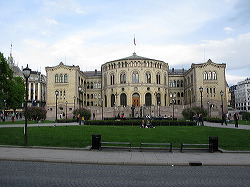 The Norwegian Parliament, Stortinget 1861-66, architect Emil Victor Langlet (Tour 1) 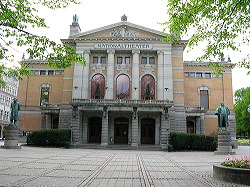 The National Theatre 1891-99, architect Henrik Bull (Tour 1) 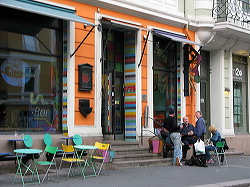 Clodion Art Cafe, Bygdøy allé 63. 1897, architect Maruis Leyell History of Oslo
The history of Oslo goes back to around year
1000 AD. Since the Middle Ages Oslo has gone though great
changes, even the name of the town has been changed a few
times, before it became the city it is today.
Oslo,
Kristiania or Christiania? Medieval
Oslo The
renaissance town
This part of Oslo's centre between the Akershus
Fortress and Oslo Cathedral, Øvre Vollgate and
Skippergata is today known as Kvadraturen ("the
quadrature") because of the rectangular street
pattern of Christian IV's renaissance town. Several
well-preserved buildings from the 17th century can
be seen here. In Kvadraturen you can see the
building that housed Oslo's first town hall, and the
city's oldest restaurant,
Café Engebret.
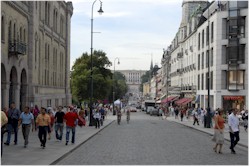 Karl Johan Street (Tour 1)
A capital
is built Historical
Oslo
The industrial era started along the river Akerselva
around 1850. In the years between 1850 and 1900 the
population of Kristiania increased from about 30,000
to 230,000 mainly due to an influx of workers from
rural areas.
The river Akerselva was the cradle of industrialism in Norway. A walk along the river is a pleasant experience and offers interesting meetings with living cultural memories. Cascades and old wooden houses provide a contrast to the enormous industrial buildings. In Frogner Park you find the Oslo City Museum. If you want to increase your knowledge about the history of Norway's capital, this is the place to go. The museum presents models, objects and photos that together paint a comprehensive image of city development, commercial and cultural activities, street life etc. through Oslo's long history.
|
|
TRAVEL TO OSLO:
Recommended arrival in Oslo:
- Friday September 12 if you want to join the Oslo tours Saturday (see the Tours and Events page). - Or any time Saturday September 13 for the start-up of the congress, Sunday morning. Recommended departure from Oslo: Wednesday September 17. Or late Tuesday 16. The congress program ends at 18.00 The congress program ends at 17.00 (you will miss the closing party). Transfer from the venue to Oslo airport takes less than one hour.
By train:
International connections via Copenhagen, Gothenburg and
Stockholm
By ferry:
Daily ferry connections to Copenhagen and Fredrikshavn, Denmark,
and from Kiel, Germany.
By airline:
Airport transfer: Oslo Airport Gardermoen is located 40 km north of Oslo. We recommend airport transfer by the Airport Express Train. It runs every ten minutes and takes 20 minutes to the Oslo Central Station (5 minutes by taxi, 10 minutes walk from the recommended hotels). 20 Euro one way. Taxi takes 40 minutes and could cost 100 Euro.
(Ryanair and some KLM flights use Torp
Airport, 120 km south of Oslo and serviced by coaches).
FLIGHTS FROM US:
Continental Airlines has daily
flights to Oslo from New York / Newark.
Other airlines, including
Scandinavian, Air France and British Airways, have
connections to Oslo from US via Copenhagen, London, Paris,
Amsterdam and other cities.
Some airlines offer stopover in
European cities at no extra cost.
If you would like to visit also
other European cities, a return flight from US to Oslo
can easily be combined with budget return flights from
Oslo most European cities. Cities like London, Paris and
Berlin are less than two hours from Oslo. Stockholm and
Copenhagen less than one hour.
------
FLIGHTS FROM EUROPE
AND ELSEWHERE
There are direct flights to Oslo from most
European countries, with connections also to countries outside
Europe.:
Oslo's main airport is Gardermoen, 20 minutes by
express train from downtown Oslo.
Please note that Ryanair, and some KLM
connections, use what they call "Torp airport Oslo", 120
kilometers and almost two hours
by bus from Oslo.
SAS Scandinavian
has connections to Gardermoen from all major European cities,
many direct:
-------
Norwegian Air:
Budget airline (from 30 - 50 Euro one way)
with direct flights to:
Berlin
Bordeax
Copenhagen
Dubrovnik
Düsseldorf
Edinburgh
Gdansk
Hamburg
Krakow
London
Madrid
Munich
Nice
Paris
Pisa
Prague
Riga
Rome
Salzbug
St. Petersburg
Sockholm
Tallinn
Venezia
Warszaw
----
Ryanair
Cheap direct flights to Torp Airport,
120 km by airport bus from Oslo, to
Barcelona
Birmingham
Bremen
Dublin
Frankfurt
Glasgow
Liverpool
London
Madrid
Marseille
Milan
Pisa
KLM, British Airways, Brussels, Air France
and Lufthansa also have flights to Oslo.
CARBON OFFSETS:
All attendees are encouraged to purchase
carbon offsets for their travel.
Read about carbon offsets on the World
Wildlife Fund web site:
WWF recommends Sustainable Travel International /
my climate:
How to calculate your emissions from
a flight to Oslo, and buy carbon offsets
Read about effective carbon offsets and
how they work at the David Suzuki Foundation's website:
There are also other NGOs offering
carbon offset programs.
------------------------------------
|
Sponsoring
Some of the participating NGO's IPPC - Intergovernmental Panel on Climate Change
EEA-
European Environmental Agency
CNU -
Congress for INTBAU
Wuppertal Institute Duchy of Cornwall, UK
Leibniz Institute American Planning Association,
The
Princes
Netherlands Institute Academy of Urbanism, UK Urban Renaissance Institute, UK Urban Land Institute
National
Resources Defense
Council, US Oslo Byes Vel
University
Technical
University Columbia University
Royal
Institute of Technology, Timisoara University, Romania
Universidad
University
University
of University of Illinois
University
IUAV
Universidad
University of Porto University of Sumatra University of Sydney
Victoria
University Virginia Polytechnic Institute University of Miami University of Notre Dame, US University of Oregon University of Havana
Riksantikvaren - City of Oslo
London
Borough
City of
Modesto,
City of
Tshware, City of Gerbsen, Germany
City of
Sundern, Germany City of Santa Fe
|
|||||||||
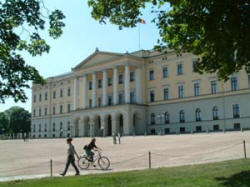 The Royal Palace
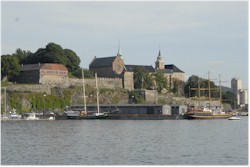 Akershus Fortress