ARCTIC
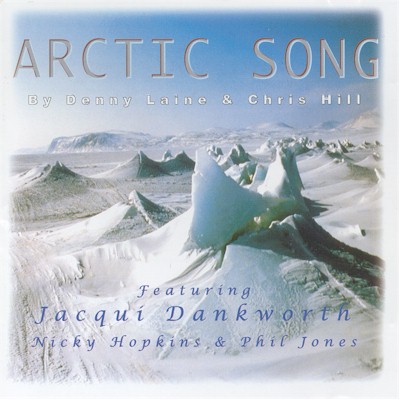
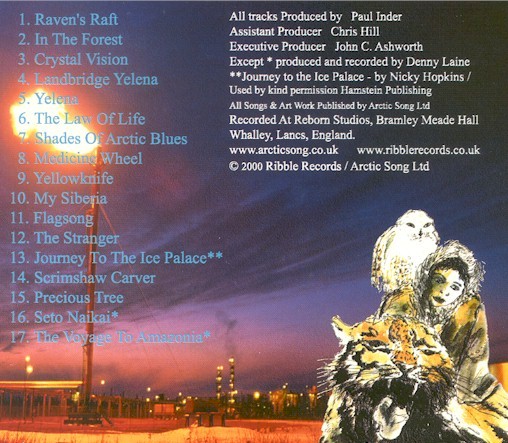
SONG - The musical
Songtexts
 Click for larger images
INTRODUCTION
Journey Round The Arctic Circle
Being
asthmatic, and as a member of the National Asthma Campaign in Cambridge, I
was aware that there was a dramatic increase in asthma, especially among
children. My search for a solution to this life threatening condition led
me to believe that the “air we breathe” was contributing to an
increase in new asthmatics. Asthma has doubled in the last 20 years and
stands at 3 million in Britain, one million children and 1,600 deaths a
year. Children are beginning their lives breathless, on steroids and
inhalers, what does the future hold for them?
In
trying to find an answer, my intuition led me to the Arctic, where one
would expect to find clean air, away from our polluted cities. But instead
of finding a pristine environment, I discovered the Arctic too was under
great stress. A hole in the ozone layer and oil spills in Alaska. Fallout
on the tundra from radioactive dust clouds from Chernobyl in Russia. Dead
lakes, rivers and acid snow, Arctic Haze, caused by soot from Southern
industrialised nations and global warming. Native Arctic people, told me
the colours of the sunsets have changed, the skies once blue, have become
milky. The Arctic`s “wildlife and people” are suffering. The Siberian
Tigers is on the verge of extinction. A Native Canadian, told me “I live
in the High Arctic, I thought our air was clean, my children have recently
been diagnosed as asthmatic”.
The
inspiration for the musical ARCTIC SONG, came from my solo journey,
producing a book called “Journey Round the Arctic Circle”,
commissioned by Cambridge University Press. I travelled to Alaska, Canada,
Greenland, Iceland, Lapland in Norway, Sweden, Finland and Siberia,
working in temperatures between minus 25 C to 70 C below zero. ARCTIC SONG
the musical would try to encompass the Arctic`s beauty and what is at
stake, if we do not protect this precious ecosystem.
The
Arctic made me aware that there is a “Law of Life” a harmony of people,
wildlife, ecosystems, working together. When we break this trust, discord
is created. We are the guardians for our children and environment. The
skies are the lungs of the earth, we are changing the chemistry. While in
a small boat off the Greenland coast, among cathedral size turquoise
icebergs, my Inuit friend and I averted a head on crash with a whale.
Instead of being angry the whale gently stood on his tail, metres from our
tiny boat. I could hear its lungs breathing like giant bellows and I had
eye contact, it was like looking inside the soul of the world – as if it
was trying to talk, maybe a warning about the “air we breathe” or The
Ghost of the Scrimshaw Carver. We would have perished if he tipped us into
the frozen waters. He disappeared when a large killer whale came into view.
He dived and his tail made three large circles in the Arctic Ocean, our
boat bobbed in the wake and we headed back to camp at the foot of the
Greenland Glacier. On the way back I found the weathered root of a tree
drifting on the tide and wrote down the idea for a song Precious Tree.
On
my return to England I met up with an old friend, Denny Laine. He had just
written a song called “Rescue my World”. I have appreciated Denny`s
contribution to the music business for many years, his dynamic blues voice
and guitar playing, his songwriting is always on the leading edge of new
music concepts. He stays in touch with nature. If you cannot get hold of
Denny he is probably on a boat or a trailer in the countryside writing a
song. We have similar feelings about environmental issues. I gave Denny my
original storyline, characters and ideas for lyrics, from which he created
a ROCK MUSICAL. He added the music, and his own ideas to complete the
storyline and lyrics, and the Musical ARCTIC SONG was born.
If
“civilised man” fails to cherish and preserve his ecological twin from
global warming, “Raven`s Raft”, the Artic peoples mythological
equivalent to Noah`s Ark could set sail once again.
If
we wish to share the beauty and magic of this threatened land, to preserve
this purifying element of our planet, then we need to understand the soul
of its people, the wildlife and the ancient wisdom of their Shaman. We
need to hear their ARCTIC SONG.
CHRISTOPHER
HILL
Fellow
of the Royal Geographical Society May 1997
CONTENT
Preface
When
man set out to explore the Earth he took with him his heritage, his
customs and habits of a life-time. Hence the English settled in a similar
place with the same four seasons, the north-east coast of America – the
Spanish in the hotter region of the west-coast and so on.
This
has been the case with the planet Arcturus. Many thousands of years before
the legendary Gods and animals of the Arctic Circle had fled from Earth to
escape the harsh conditions of the Ice-Age and discovered a beautiful
planet that had crisp and warm fruitful summers and hard barren winters.
Here they developed into a divine race. They built city farms and
bio-shelters to convert their waste products into clear water thus
avoiding pollution and gradually, because theirs was a new beginning, they
worked together to create peace and harmony with their environment. Man
and beast had a mutual respect and treated each other as equals. Their
laws were strict and effective, in favour of the preservation of their
planet, and violence and greed were dealt with severely.
The stranger
The
Stranger is sent from a nearby planet, as an envoy, to investigate the
environmental problems which have caused the earth`s ozone layer to leak
poisonous gases into space. He has the ability for change his form into
any being he may encounter on his mission, in order to communicate.
His
craft enters the atmosphere through the ozone hole and lands in remote
Siberia.
Shades of Arctic Blues
As
The Stranger emerges he sees a raven and he approached him to ask his
advice. The Raven is known as the Earth`s messenger and as such he
explains that the Arctic is a place where only the strong-hearted survive,
ruled by nature`s extreme conditions. There exists a constant battle
between deep-rooted folklore and the disruption and pollution caused by
progress. For the most part the Arctic remains one of the words most
beautiful and untouched areas, a haven for wildlife, an awesome land of
experience and historic values.
The Law of Life
Raven
leads The Stranger to a nearby village. He arrives during what seems to be
a crucial local meeting. A great gathering of natives crowd the clearing,
while wild animals watch curiously, hidden by the brush at the fore`s edge,
as the holyman speaks of the life-threatening pollution that is forming in
the sky above them and what they must do to prevent a global disaster,
should the ice-caps melt and envelope the Earth.
Yelena,
a yong peasant girl, moved by his words of wisdom, volunteers to lead an
expedition to gather knowledge and spread the word to other nations, as
they go in search of “The Arctic Song” – the seed of harmony and
balance of nature.
My Siberia
The
Stranger introduces himself to Yelena as Arcos, an explorer, and explains
that he too is determined to fight for the same cause, and offers to
accompany her on her voyage. She tells him of her life and love and
respect for the animal kingdom, and that man, in his eagerness to go
forward, is destroying their means of survival and forcing many of them to
become extinct. She insists that without their help and understanding as
guides and bearers, the expedition would not be possible.
The Landbridge
In
ancient times when the great continents were joined together, Yelena`s
ancestors would have ventured across the narrow strip of land known as the
Landbridge, to hunt and explore the area now called The Americas. Now the
journey would have to be made across the frozen North-West Territories in
hazardous conditions. The link between East and West must be secured and
so, armed with the will to succeed, Yelena, Arcos and the animals they
have chosen to help them set off, like their fore-fathers – to
re-discover the West.
Yellowknife
Eventually
they reach the Great Lake Slavey where, upon its shores, lies the city
Yellowknife. Here they are confronted by a total culture shock, and they
realise that the old and new lifestyles really do co-exist, and that it
isn`t going to be easy to draw the line between who is right and who is
wrong. As they approach the city the animals find a place to camp as
Yelena and Arcos leave them to explore the human activities and the
night-life. They are attracted by the raunchy music coming from a downtown
bar, and they enter a world neither of them could have ever imagined.
The Ghost of The Scrimshaw Carver
After
seeing the industrial machinery pumping waste into water that we drink and
the air that we breathe, Yelena is curious to see what effect this will
have on the sea-life and the shorelines. They reach Baffin Bay, the
infamous whaling griunds, and discover a huge boiling-pot which would have
been used in the past to boil down the whale blubber to produce oil. As
they contemplate the scene they experience an apparition as eerie sounds
emerge from the cauldron. The ghost of an ancient mariner tells of his
demise as a whales in the nineteenth century, and the appalling carnage
that was the beginning of the end for the then large whale population.
Medicine Wheel
Emotional
strain and physical fatigue is beginning to show on the faces of the
earthlings. Arcos decides that the time has come to reveal his true
identity so he can use his advanced powers to prove to the others that
they can succeed as a team. He tells them of his world, how they have
mastered the art of evolution without resorting to wars or massive waste
and destruction.
Yelena,
in a state of shock, compares his story withthat of the “Medicine Wheel”,
the self-healing process that has been handed down to her people for
generations. Whit so much to think about she leaves the group for a while
to meditate. She has fallen for Arcos and is confused. Would they have a
future as a couple or would he return to his planet. She heglects herself
and becomes ill, and is found by native women and taken to their village.
Flagsong
As
she wanders into semi-consciousness, she has a vision of past explorers
claiming their rights over land, planting their country`s flags in the
snow. But she is weak and cannot protest, until Arcos arrives to destroy
the flags and declares the areas, Free-Zones. This fills her with
happiness and hope, though she is still very ill.
Yelena
Arcos
is worried that Yelena has been frightened off by his confession and
realising that he is experiencing human feelings, he calls on the elders
of Arcturus for guidance. They tell him that his mission is of prime
importance, but when completed he would be allowed to stay on Earth if he
wished.
The
true test of his love for Yelena was yet to come, they warned, and the key
to the question lay with Raven. Arcos concentrates all his thoughts on
Yelena and she receives them and recovers.
Raven`s Raft
Raven
gathers the animals togheter in secret and tells them that Yelena and
Arcos must be put to the test so as to prove their ability to lead the
qest on its next, more important stage, The Voyage.
Is
is predicted that Yelena will fall through the ice and will surely die
unless Arcos attempts to save her. The animals will build a raft, a whales
carass serves as a shell, and they will rescue the humans and be raised to
the Celestial Kingdom. From there they will be sent to various spots on
the Earth`s surfase where they will see other examples of greed and
unnecessary waste and also areas where life has been preserved just in
time.
The Voyage to Amazonia
After
conferring with “voice”, they continue. As the raft circles the Earth
the smoke rising from a dense jungle. They are drawn towards the fire
below by a menacing wind current and narrowly miss disaster as they emerge
through the dancing flames and smoke to settle upon the waters of the
Amazon River. Above the sound of crackling fore and falling trees they can
hear the hideous sound of frightened fleeing wildlife.
In The Forest
On
the opposite bank to the oncoming fire, a group of Indians are lamenting
the death of their homeland, as the tide of progress destroys everything
in it`s wake.
In
their own simplistic way they tell of the natural process that supplies
them all with abundant food and the need for the sustenance and
re-generation of the rain forests of the world.
Precious Tree
The
group are deeply saddened to witness yet another scene of total violation
of the Earth`s resources. They travel to the nearest city where there is a
carnival in full swing. In their oblivion, the city dwellers disregard
Arcos and Yelena`s attempts to draw their attention to the fires that are
burning while they enjoy themselves.
In
desperation the group decide to join the procession, using The Raft as a
“Float” as they perform a blatant protest song to the now captivated
audience.
The Breaking Point
As
the sun rises they are crossing the Atlantic Ocean towards the coast of
West Africa. Flying low they pass over the war zone of Angola, the raft
occasionally rocking as it feels the slight turbulence from distant
explosions. They then head north east where they see the drought ridden
refugee camps of Ethiopia and finally the Middle East where the worst of
man`s conflicts are evident, focusing as always, on the unequal
distribution of natural resources. B elow them the sea is black with crude
oil, as far as the eye can see and the sky is so dark from burning wells
that the travellers are convinced that it is night time. The landscape is
a tangled mass of destruction resembling a giant scrap-yard and the
unmistakable smell of war is everywhere. Arcos sadly reminds the others
that all this is a vivid example of gross negligence and mismanagement of
the environment and is rapidly spreading as the world`s population
increases at an alarming rate. The Arctic Song seems to be impatient and
pulls them above the oily clouds and eastwards to continue their journey
not knowing what to expect.
Seto Naikai
Jorney
home to Siberia, The group land among the Ainu (The “Hairy Ainu”), the
original inhabitants of Japan who were driven North centuries ago. The
travellers meet and doscuss their mission with the ainu elders, and are
advised to travel South to Seto Naikai (the inland sea) where pollution,
decades ago, was overcome.
Here
they are greeted with great enthusiasm. As the new leaders, in the field
if optimism and humanitarian projects, the Japanese pledge their support
for the future, and advice on any matter concerning the preservation of
sea life, as they now seem to have acquired a reputation as experts on the
subject. As the Raft departs, they pass over Seto Naikai and the group are
filled with new-found hope for the survival of the threatened sea-world.
Crystal
Vision
Blinded
by their vivie experiences, the group travel in silence back to the
Kingdom. As they approach the North Pole, they can see the colours of the
“Aurora” converging into a giant test tube as Father Time stands by,
more ingredients gather in the tube and a chemical reaction seems
inevitable. The Raft passes close to the entrance, and in itsslipstream
draws the bad elements up into the stretosphere and, for the time being,
out of harms way.
They reach their destination, fully aware that the life of the Earth does indeed hang in the balance. Some of us care, while others only live for the moment; not realising that a moment is all it takes for the wrong element to enter the test-tube, causing the explosion that will destroy the earth completely.
___________________________________________________________________
ABOUT
ARCTIC SONG
Arctic Song
In
the late 80`s author and photographer Christopher Hill first used the
title “Arctic Song” for his concert at the Cambridge Corn Exchange.
Performers from the Arctic mixed with various familiar faces, including
myself, in a cultural extravaganza to highlight the results of his
research gathered from various trips to the north. Asthmatic Christopher
intrepidly sought to arm himself with the knowledge that is the very
essence of this fascinating story. We had been friends in London in the
60`s and now fate had brought us together again to consider the
possibility of writing a musical together. On that basis Christopher piled
up all his notes, pictures, the first draft of a storyline that included
characters and sketches, notably that of “The Ghost of the Scrimshaw
Carver”, tapes of Inuktituk throat singers, titles, names and
strange-sounding places and placed it all in my somewhat bewildered lap.
Imagination began to run wild and the story extended beyond the Arctic to
outer space, eventually involving our planet`s ecological problems as a
whole and, after a few more years of trying to bring it to the public`s
attention it has finally emerged as a stage production, thanks to the help
of Ben Ashworth who suggested it to his drama teacher (Mary Jones) who
then contacted me. In a surprisingly short time, due to the talents and
professional approach of teachers, parents and pupils, the debut of
“Arctic Song” at Stonyhurst College is about to take place.
Enjoy,
Denny Laine
_____________________________________________________________________
Statement made by Sir Rannulph Twistleton-Wykeham Fiennes
“Scientists
on my expeditions to both Poles have studied pollution (present in the
air, snow and ice) between 1976 and 1993. Evidence of serious
deterioration is not hard to find. From and at our base camps in the
Canadian and Siberian Arctic as well as those in the South African /
Norwegian and the UK / Chilean sectors of Antatctica, we have collected
alarming facts and figures that indicate far more pollution-prevention
measures be taken internationally and quickly. Our work has been merely
superficial compared to that of the permanent govermental scientists yet
it has been sufficient to alarm us greatly and to wonder why the
goverments who receive the reports and clearly hear the alarm bells
ringing both North and South do not react far more radically than they
have to date.
Hopefully
Christopher Hill`s book will help to sound the alarms ever more strongly.”
September
1993
____________________________________________________________________
From: The Rt. Hon. Lord Shackleton, KG, FRS
Christopher
Hill`s journey around the Arctic circle was undertaken at a very
significant time in the history of the Arctic. It came at a time of great
concern at the dicovery of environmental damage to the Arctic by man.
The
Arctic is a unique, pristine, serene wilderness, where the people and
ecosystem are under great stress from the pollution of industrialised
nations.
In
the short space of two years Christopher Hill witnessed in his travels an
escalation of the environmental threats to the Arcic. The discovery by
international scientists of a hole in the ozone layer, the greenhouse
effect, global warming and the possibility of melting ice caps have caused
serious alarm. The phenomenon, Arctic Haze, has changed the colours of the
sun sets and also creates acid snow and rain. The Saami in Saamiland (Lapland)
are still feeling the effects of radiation from the nuclear power station
accident in Chernobyl in the former USSR. The Exxon oil spill in Alaska
has had serious consequences for the local terrain and wildlife and in
Russia industrial waste has caused Arctic rivers and lakes to “die”.
Let`s
try and keep the Arctic free from pollution. It is a delicate ecosystem
which has taken millions of years to evolve and can give pleasure for
generations to come.
I
hope that this book will give an insight into what is at stake in the
Arcic and that children from all around the world can enjoy and share some
of it`s treasures.
N.B.
Arctic Haze is caused by smog in the atmosphere being blown by the wind
from industrialised countries and accumulatong in the Arctic atmosphere.
Spring
1993